- Jerusalem Interfaith Center
- Posts
- From Ohr Torah Interfaith Center to the Jerusalem Interfaith Center
From Ohr Torah Interfaith Center to the Jerusalem Interfaith Center

Jerusalem Interfaith Center
March 12, 2026
A Moment of Transition

Over the past years, our work has expanded in scope, responsibility, and reach. The questions we engage, the partners we work with, and the spaces we are invited into have changed and so has the language needed to describe what we do.
On top of this, the current upheavel in the Middle East may open new venues for interfaith diplomacy and collaboration, which we could not even imagine until now.
For this reason, the Ohr Torah Interfaith Center is becoming the Jerusalem Interfaith Center (JIC). It reflects a deeper clarity about our role.
Jerusalem is not only a place but a moral and spiritual crossroads that remains contested, demanding, and unavoidable. To work seriously on interfaith relations today means engaging religion where it actually shapes lives, power, and identity.
The name Jerusalem Interfaith Center reflects that responsibility.
Reviving the Ancient Jewish-Iranian Alliance

The joint Israeli-American operation is not targeting the Iranian people, it targets the totalitarian Iranian regime that has spread death and terror throughout the region and the world for decades, motivated by a twisted understanding of Islam.
The operation may open up new possibilities for Jews and Iranians to work together, and we already see messages of hope sprouting and a vision for reviving this ancient alliance forming.
Check out this short video by Rabbi Lavi, addressing the Iranian people directly
And this video by Rev. Foad Khorshidi of the Cyrus Fund, who addresses the Jewish people.
Both share special and reciprocal messages rooted in a shared history and relating to the celebration of Purim.
Standing for One Another at the IRF Summit

Rabbis Nagen and Lavi recently returned from the International Religious Freedom Summit in Washington, DC, where the meaning of this transition became especially clear.
The IRF Summit brought together leaders from across faiths and regions, many representing communities under real threat. What stood out was not uniformity, but courage and the willingness to step outside one’s own narrative and take responsibility for the other.
A Muslim leader decried antisemitism.
A Jewish rabbi represented persecuted Falun Gong practitioners in China.
Faith leaders refused to compete in victimhood and instead protect one another.
At the closing event of the summit, Rabbi Lavi had the honor of speaking on behalf of the persecuted Falun Gong community, a spiritual movement developed in modern China aimed at meditation and qigong exercises to align the chi. Alongside him, a senior Ahmadiyya Muslim leader, Khalid Hussain, spoke explicitly about the rise of antisemitism and its danger not only to Jews, but to humanity as a whole.
Hearing a Muslim leader articulate this so clearly was a reminder of why interfaith work matters especially when it is grounded in moral responsibility. When leaders speak beyond their own identity lines, religion stops being a divider and becomes a shared language of accountability. That is interfaith work worthy of Jerusalem.
Engaging Global Muslim Leadership
During the summit, we were also invited to a special event in the U.S. Congress honoring His Highness Sheikh Dr. Muhammad Al-Issa, Secretary General of the Muslim World League.
Sheikh Al-Issa has emerged as a significant voice in confronting antisemitism and engaging Muslim leaders with the reality of the Holocaust. He consistently speaks for an Islam that faces hatred honestly rather than deflecting it.

At the event, we presented him with the Jewish–Muslim Religious Fraternity booklet in Arabic, continuing a relationship that began when we last met in Bali at the R20 conference, where we presented him with an Arabic-version of the Torah translated by Rabbi Saadia Gaon.
These gestures are part of a long-term effort to bridge gaps between religious leaderships that rarely speak the same theological language, but must learn to do so to overcome the powers that try to divide us.
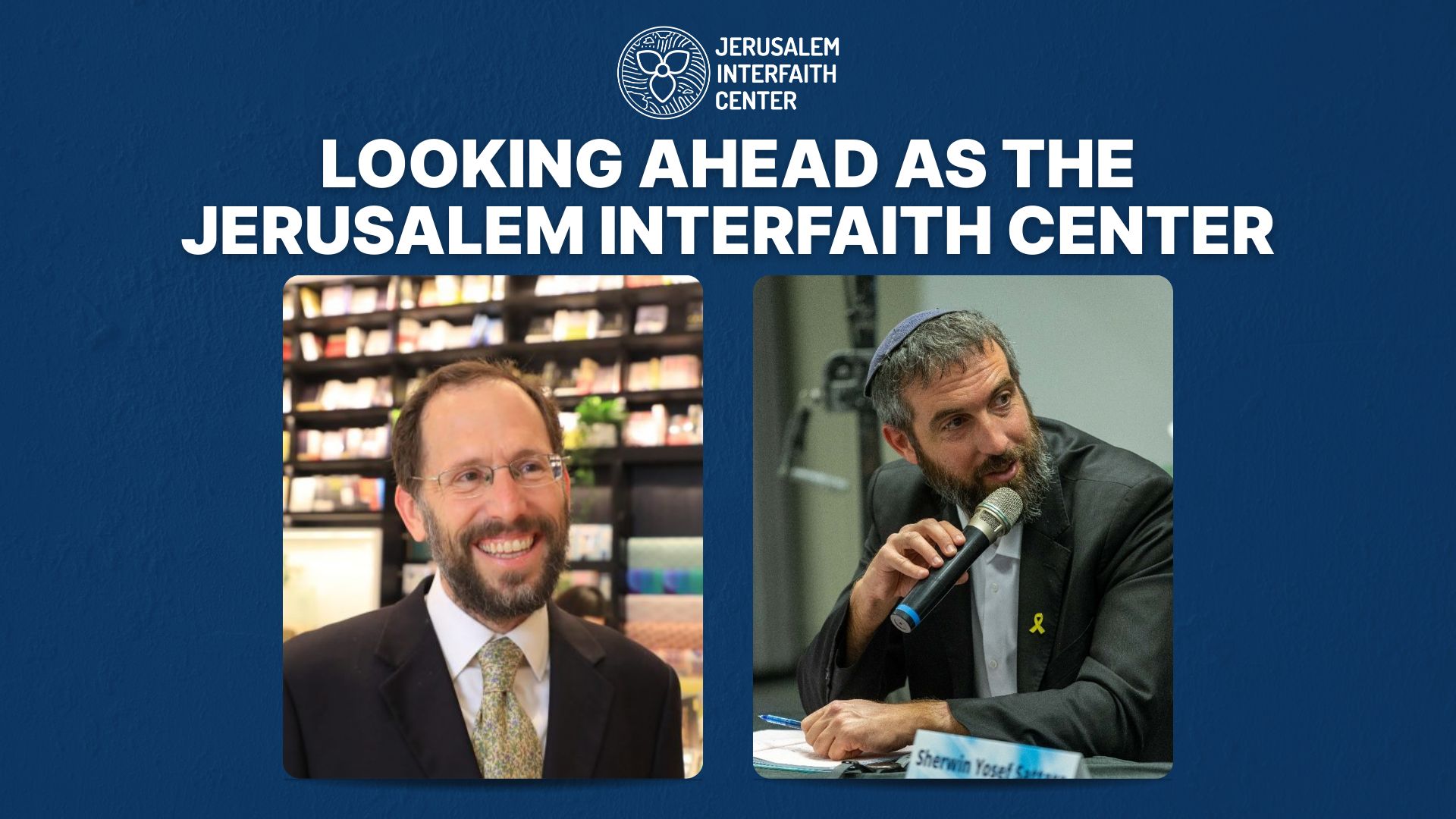
As we move forward under the name Jerusalem Interfaith Center, our commitment remains unchanged.
We will continue to:
Engage religion seriously, not symbolically
Work with leaders willing to speak with moral clarity
Invest in long-term relationships
Build interfaith partnerships rooted in responsibility
In the coming weeks, we will share more about what this transition means, how our programs are evolving, and how you can be part of the next chapter.
For now, we wanted to mark this moment: one of continuity, clarity, and commitment.
Thank you for standing with us.
Rabbis Dr. Yakov Nagen and Aharon Ariel Lavi
Jerusalem Interfaith Center (JIC)
Follow JIC’s ongoing work in building faith-based cooperation across the world:
Your support fuels JIC’s mission to foster interfaith dialogue and reconciliation. Here’s how you can help:
🤝 Donate: Your contributions help expand our programs, create educational materials, and support community outreach.
Spread the Word: Share OTIC’s mission on social media
Together, we can build a Middle East defined not by rivalry, but by reverence.